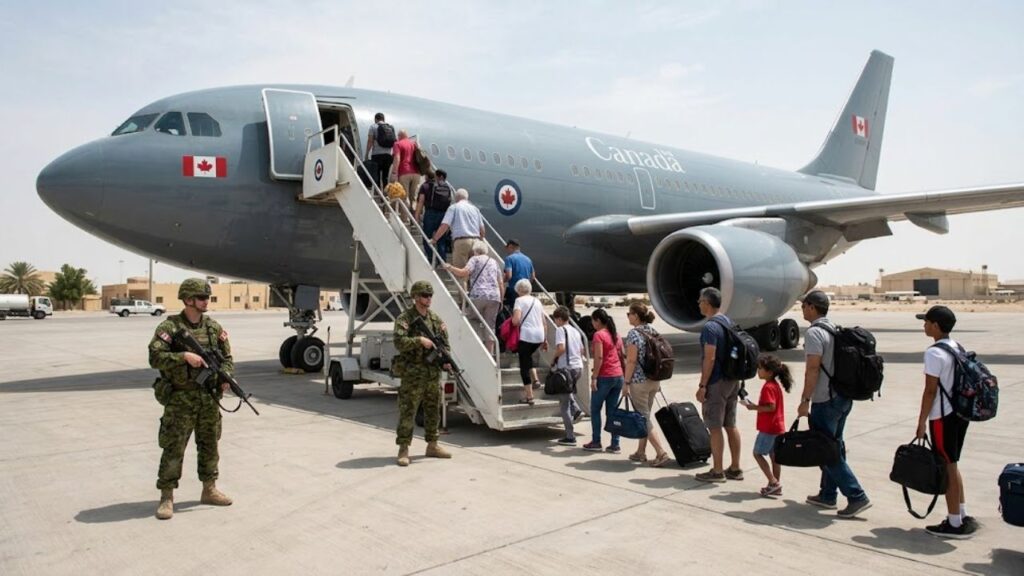
Since the U.S. started its war with Iran on March 28, Foreign Affairs Minister Anita Anand has said that her main goal is to help Canadians who want to leave the Middle East.
According to her department, nearly 8,500 Canadians and permanent residents have returned home from the region as of Friday. More than 1,000 people have also left the Middle East for safe third countries.
Why does Canada help people leave?
Ottawa has said that it is not legally required to get Canadians out of crisis areas. It’s not a right, but a service that Canada offers. Canadian politicians often talk about it a lot on social media.

Global Affairs Canada has an emergency response center that helps Canadians who are dealing with things like losing their passports or being arrested in another country. During times of crisis, that center gets more staff to help embassies coordinate information about commercial flights. Sometimes, the federal government hires planes or asks the military to help people get out of the country.
Canada often works with other countries that think like it to share resources for evacuation. For example, Canadians who want to leave Sudan might get on a French military plane, while Australians who want to leave Dubai might get on a flight to Istanbul that Ottawa has chartered.
Global Affairs Canada also sends out travel warnings that tell Canadians not to go to certain places in the world because they are not safe. For months, Ottawa has told people not to travel to Iran. For years, it has either told Canadians not to go to places like Israel and Lebanon at all or to only go on necessary trips.
How does it work?
A lot of video calls. On Thursday, Sébastien Beaulieu, GAC’s director for international emergencies and travel advice, told senators that Global Affairs Canada has staff join daily coordination calls with their counterparts in the Five Eyes intelligence alliance during major crises.
He said, “We share information not only about what is happening and how the conflict is changing, but also about the pressures on the ground and what each of us is doing.” He also said that Canada has agreements with France, the European Union, and Japan on evacuations.
People who sign up with Global Affairs Canada get the most up-to-date, verified information from crisis zones in both English and French.
Beaulieu said that when diplomats plan evacuations, they always look for commercial airlines first. He said that commercial airlines are the cheapest option and are best able to bring evacuees directly to Canada instead of making them go to a third country.
The government will often “block-book” airline seats for citizens to reserve and pay for themselves, sometimes using codes that are given to them. When commercial options are full, Ottawa can also hire buses or planes to fly people to their destinations.
Beaulieu said that the military could help get Canadians out of the Middle East “but we are not there yet.” In the past, military helicopters and planes have helped Canadians leave places like Haiti and Sudan.
Beaulieu said that Canada is relying on diplomats it thinks are necessary to help Canadians abroad get to safety. The original plan to send home non-essential staff and family members from Tel Aviv has now been expanded to include Ramallah, Beirut, and Baghdad.
If there is an evacuation in Cuba, where a U.S. oil blockade has made a humanitarian crisis worse, diplomatic staff may be needed to help. Beaulieu said that the embassy in Havana is dealing with the fuel shortages by using solar panels when they can and cutting back on the hours it is open. He also said that Cuban government departments are doing the same thing.
What is causing demand to go down?
Pictures of Iranian drones hitting tourist areas in Abu Dhabi and Doha shocked the world. Some Canadians in those cities have since found their own ways out, while others have stayed where they are or downloaded apps that warn them of incoming strikes.
Beaulieu said that in the days after the U.S. started its war on Iran, GAC had “over three shifts of 50 people per day” answering calls from Canadians in the area.
The department has since cut that number of staff by a lot because the number of daily inquiries has dropped from a high of 1,400 in the first days of the war to 400, he said Thursday.
Beaulieu said that these calls are not just coming from Canadians living abroad. He said that “in many cases,” their family members call to ask for help with getting a new passport or finding travel options.
In the meantime, the Kuwaiti government has been stopping foreigners, including Canadians, from leaving the country without a permit that requires them to talk to their boss.
Anand said on Thursday that she had talked to her Kuwaiti counterpart about the issue and that they had agreed to “speed up the ability of Canadians to leave.” Ottawa is making a list of people who are having this problem.
On Friday, Anand wrote on social media that “delays are affecting the delivery of passports in some parts of the region because airspace is closed.” The problem will get better as air travel slowly starts up again.
Why are some Canadians not leaving?
A lot of Canadians live full-time in places like Dubai, where they have good jobs, or Beirut, where they might have strong family ties. Many Canadians in Iran have said that family obligations, like taking care of sick relatives, keep them from leaving.
A lot of Canadians in Lebanon have been through a lot of wars and crises there and don’t seem to want to leave.
On March 7, Global Affairs Canada reported that just three per cent of the 24,045 Canadians registered in Lebanon had sought help to leave the country. Fourteen percent of the 30,421 Canadians who live in the United Arab Emirates have asked for help.

The Access to Information Act gave The Canadian Press access to documents that show that interest in Ottawa’s effort to help citizens and permanent residents leave Lebanon during the Israeli invasion in 2024 dropped off dramatically within days of that campaign starting.
Canada spent $11 million to keep charter planes on standby for three months starting in August 2024. In October of that year, they spent about $4 million to fly 844 Canadian citizens, permanent residents, and their families from Lebanon to Istanbul.
The federal government was able to get 300 foreigners on those flights with Canadians, but hundreds of seats were still empty.
There was also a lot of debate about the military-assisted evacuation of Lebanon in 2006. Taxpayers spent $94 million to airlift 15,000 Canadians, some of whom were called “Canadians of convenience” by then-MP Garth Turner, who said that many of them had only loose ties to Canada.
How much does this cost?
A lot. Evacuations are only partially paid for. Ottawa charges Canadians for flights and bus rides to different places, and the prices are often similar to what a commercial option would cost if it were available.
Beaulieu said that this was the plan for a flight that Ottawa hired to go from Dubai to Istanbul.
“We found out how much a flight would cost on Expedia in normal circumstances, and that’s what we decided to charge Canadians,” he said.
That means Ottawa has to pay extra for chartered flights and the time it takes for staff to plan and communicate.
We won’t know how much the current operations will cost for a few months, but we can look at recent examples.
In 2024, GAC spent almost $10 million on its consular response in Haiti, which helped 681 Canadians leave that country.
GAC set aside $40 million in 2024 for evacuations in the Middle East as the Israel-Hamas war spread to Lebanon.
Anand said on Thursday that the cost-recovery model is meant to show fiscal responsibility, but the main goal is to keep Canadians safe.
“We need to make sure that Canadians always have safe ways to leave, which is why we made sure we had more than one option,” she said.
Can this last?
Not really. Last May, when Anand started her new job in the Global Affairs Canada department, the department’s briefing binder made it clear that the world’s growing instability is making the work of protecting Canadians abroad much bigger.
The binder said that Canadians might have to pay more and get less now that big crises happen every few months and Ottawa is trying to help not only citizens but also permanent residents and their families.
The department said that the consular fee for renewing passports, which is supposed to help pay for all kinds of help abroad, hasn’t gone up since 2013.
Global Affairs Canada is losing money, which will mean layoffs and a race to find ways to save money. The budget from last November said that GAC would “revamp emergency preparedness and modernize consular services” to save money.
Anand said in November of last year that she was “sure that these cuts won’t affect the services that Canadians depend on when they are abroad.”
Beaulieu said that the department has improved its technology and now has new ways to get information from 12 different diplomatic posts in the area.
Canadians who want to take charter flights can pay ahead of time through an online portal or have family members do it for them. Beaulieu said that people who can’t afford a flight can still sign a promise to pay Ottawa back, but paying up front is a new thing.
He said that the rise in geopolitical crises is making Ottawa better at its job.
“We will be able to keep responding to Canadians despite the financial pressures by making our work more efficient, getting into the habit of doing this, and building a culture of crisis across the department,” he said.