You’re not dreaming if you’ve noticed a slight change in the appearance of your paycheck in 2026. The federal government’s lower 14% tax rate on the lowest bracket will be in effect for the entire calendar year for the first time this year.
The majority of Canadians will retain a slightly larger portion of their income this year due to inflation adjustments in all five categories.
I’ll break down the federal tax brackets for 2026, describe how marginal tax rates work, and offer some tax-saving tips below.

What was altered in 2026
The most notable change is the reduction of the federal income tax rate from 15% to 14%. The blended rate for 2025 was 14.5% because this cut went into effect halfway through that year. The full reduction begins on March 18th, 2026.
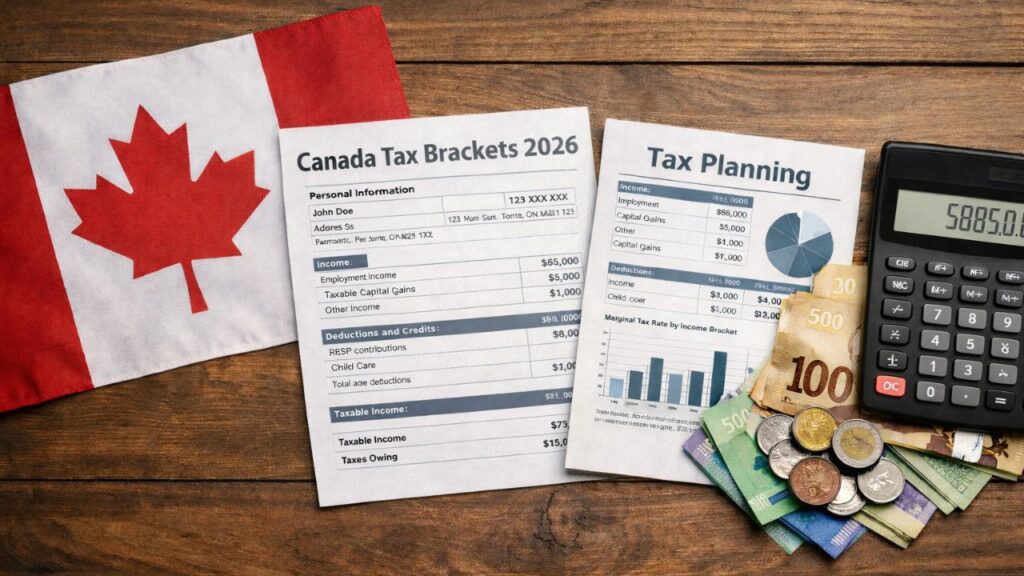
In order to account for inflation the Canada Revenue Agency has also increased all five federal tax brackets by 2%. The following are the revised federal brackets for 2026:
- 14% of the first $58,523 in taxable income (previously $57,375 at 15%)
- 20.5% of income between $58,523 and $117,045 (formerly $57,375 and $114,750)
- 26% of income between $117,045 and $181,440 (formerly between $114,750 and $177,882).
- 29% of income between $181,440 and $258,482 (previously between $177,882 and $253,414)
- 33% of income over $258,482 (formerly $253,414)
Over a five-year period the rate reduction is anticipated to save Canadians over $27 billion in taxes, according to the Department of Finance Canada. The savings are small but significant for individual households, especially those with the lowest incomes.
The operation of marginal tax rates
The idea that moving up into a higher tax bracket entails paying higher taxes on all of your income is one of the most prevalent misconceptions in personal finance. It doesn’t operate that way.
The tax system in Canada is progressive. Each bracket’s tax rate is only applied to the portion of your income that falls within it. In 2026, if your income is $70,000, you will pay 14% on the first $58,523 and only 20.5% on the remaining $11,477. In the end, your total effective tax rate is significantly less than 20.5%.
For this reason, you should never decline a raise because you are afraid of being placed in a higher bracket. Even though some income-tested benefits may be lowered at higher income levels, a higher gross income always translates into a higher take-home pay after taxes.
Techniques to lower your tax liability
- Make more contributions to your RRSP
One of the most effective ways to lower taxable income is to make a contribution to a Registered Retirement Savings Plan. Investments grow tax-deferred until they are withdrawn, and each dollar you contribute reduces your taxable income by the same amount.

The RRSP dollar limit increased from $32,490 in 2025 to $33,810 in 2026. Your personal limit is equal to the annual cap plus any unused room carried forward, or 18% of your earned income from the prior year. Using CRA My Account, you can see which room is available.
The RRSP deadline for the 2025 tax year was March 2, 2026, as tax season has already begun. Nevertheless, early planning of your 2026 contributions can still have a significant impact at the end of the year.
- Take advantage of all the credits and deductions to which you are entitled.
Many Canadians fail to take advantage of credits and deductions that they are eligible for, leaving money on the table. Filers should keep an eye out for important deadline changes and new credits this season, as CTV News recently reported. Childcare costs, work-related moving costs, the home office deduction, medical costs over a certain amount, and tuition credits are examples of common deductions.
- If at all possible, divide your income with your spouse.
Your combined household tax burden may be lowered by income splitting, particularly if one spouse makes much more money than the other. One of the most straightforward tools is a spousal RRSP, in which the lower-income spouse eventually withdraws the money at their lower marginal rate while the higher-income spouse makes contributions and claims the deduction.
Another choice for retirees is to split their pension income. You may give your spouse or common-law partner up to 50% of your eligible pension income on your tax returns. Income from a higher bracket may be pulled into a lower one as a result.
Concluding remarks
Although there won’t be any significant changes for the 2026 tax year, most Canadians will save a little money thanks to the lower bottom rate and inflation-indexed brackets.
Your response—increasing your RRSP contributions claiming all of your credits, and carefully considering income splitting—is where the true opportunity lies. You can keep more of your hard-earned money where it belongs with a little preparation today.